#Sealeychallenge Accepted!
August 27, 2025
by Lynnell Edwards, poetry faculty
As of this writing, I am a little past the halfway point in my reading for the Sealey Challenge. IYKYK that the Sealey is a formidable but rewarding challenge to read a book a day for the month of August. The modest website explains that the challenge was initiated in 2017 by poet Nicole Sealey, who, frustrated by trying to balance her professional responsibilities with promoting her first book, “decided to challenge herself to a personal goal: read a book of poems each day for the month of August.” She posted her intention to social media (of course!) and the rest is viral history: a predictable late-July rush of pledges showing stacks of books publicly declaring the poster’s intention to read.

After several summers of seeing the book-a-day-for-a-month gauntlet thrown down in these posts, I decided go for it this summer—despite my miserable failures in completing that other poetry challenge: April’s poem-a-day writing practice. But I also know that I had an embarrassing number of unread poetry collections literally lying around the house: on my nightstand, the floor of my study, the floor of my bedroom, on the steps up to my study, crammed sideways on packed bookcases. So in less than ten minutes, on the last day of July, I gathered up all the unread books of poetry I had accumulated in the last five years or so from swaps with poet-friends, review copies sent to me by literary presses, significantly discounted last-day-of-AWP purchases, and the remnants of the occasional over-ambitious bookstore haul. I assembled my own squat stack of books, artfully arranged them in natural lighting for photographing, and posted to the socials. #Sealeychallenge accepted!
Is the Sealey Challenge a little bit arbitrary? Of course, but aren’t all challenges? Is it a little bit self-serving? Perhaps, but don’t all social media-fueled endeavors have a touch of the vanity project about them? If you’re reading this essay, for example, you likely accessed it through a link shared on the socials. Has it been challenging but rewarding? Yup! I’ve discovered something about myself as a reader of poetry as well as about the landscape of poetry in the last ten years.
Beyond committing to the one-book-a-day requirement (and there’s no requirement, technically, that it be all or only poetry), there are no other rules about how or why participants curate their stack of thirty-one books. You might choose, for instance, to curate a themed list (all books by women, for instance) or a stack of only books that you have read before, perhaps stretching back into your young adult years. I can’t say that my stack was an entirely random selection, but the large percentage of books that were unsolicited review copies did give it that quality.
The only other two principles guiding me were that I began with a number of books greater than thirty-one and have allowed myself to choose a title each day, my selection usually guided by length (depending on the time I knew I would have to set aside for reading), or in some cases my mood. Second, I would not simply slip the Sealey Challenge books into my nighttime reading habit. This was about finding space—new space—in my day for poetry, and to let that practice, if only for a month, drive the shape of my day. Plus, I would likely never finish a title I began as my nighttime reading because I would fall asleep.
August began with an easy launch: a long weekend at the lake with nothing to do but sleep late, paddle around in the warm lake water, and lie on the front porch swing and read. But with my return to work on Monday, August 4, the reality of the commitment set in: I have to do this AND respond to the myriad requests and responsibilities as faculty and administrator for the Naslund-Mann School: applications, student packets, proofreading, reviewing the residency schedule. Oh, and there’s also no front porch swing at my office.
The experience so far: some knockout titles I hadn’t expected from poets I hadn’t read before that will lead me to seek out their further work; a couple of “meh” and poorly edited collections (Too many poems! You’re repeating yourself and I’m getting bored!). And, maybe not surprisingly, there are simply not any generalizations I can make about the current “state of poetry” other than there is a lot of it. We are happily at a point where the diversity of the forms, subjects, and themes is gloriously expansive and anyone complaining that all poetry is x, y, or z is simply not paying attention. The only exception to that might be that almost every book published since about 2023 has, in at least a one poem, acknowledged the convulsive events of the spring of 2020—in some cases explicitly, in others simply with a nod to injustice or contagion.
Will I do this every August? Hmmm. I don’t know. On the one hand, I suspect my tendency to collect books from various sources will not abate and so, in another two or three years, I’ll have a similar stack of titles acquired through all the usual habits and solicitations. Watch this space in 2028! On the other hand, a curated list of rereads is intriguing. Who was I when I began reading poetry in earnest and what did I want poetry to teach me? And what sort of world were poets documenting thirty years ago? A hundred years ago? I have been recording each book in a slim notebook, including a few sentences about my impressions, trying hard not to slip into book review mode. I can feel these brief summaries sharpening my reading experience and causing me to notice and note what I like, what I might try, how it might unlock a problem I’m having in a poem of my own. In short, it’s made me a student of poetry again: a formidable challenge, gratefully accepted.
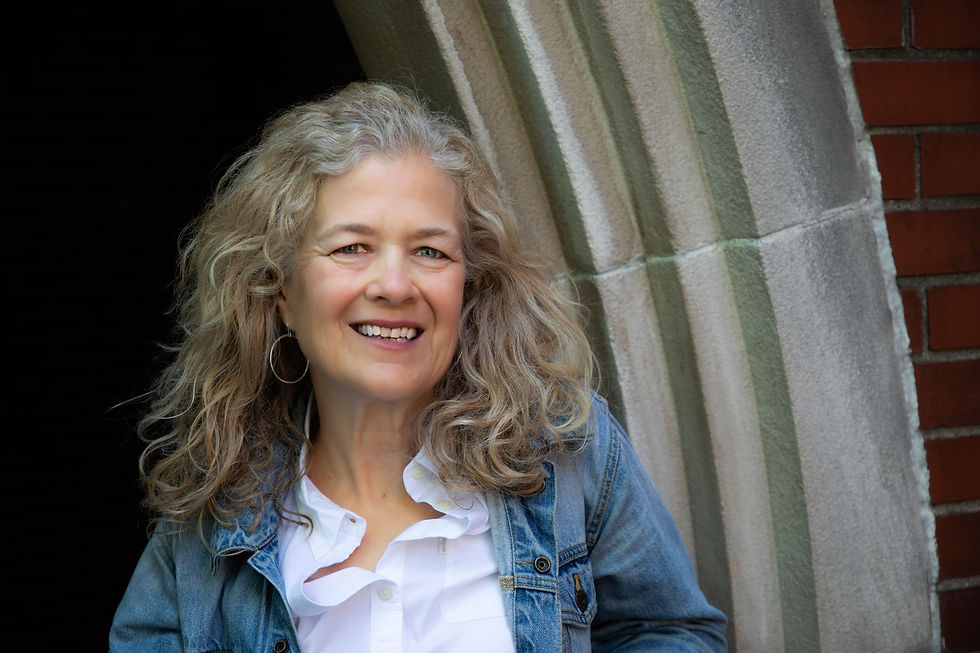
Lynnell Edwards, Ph.D, is Associate Programs Director for the Naslund-Mann Graduate School of Writing where she lectures and mentors in poetry. She is also Book Reviews Editor for Good River Review. Her latest, and sixth, collection of poetry is The Bearable Slant of Light. More about her work and writing at http://lynnelledwards.com.